

A middle-aged client with a bad back, a woman in her thirties who wants “a strong core”, an athlete thinking about longevity, someone coming back from an injury. At some point, every one of them asks you about Pilates, and some have already been to a class and come back convinced.
They have good reason. Pilates gets results with a huge range of people, and it has earned its following. It works because of mechanics - not magic.
Where the results come from
For most people, a Pilates class is the only time in their lives they’ll exercise with any degree of control. Pilates teaches control exceptionally well, helped by the fact that the workout device uses elastomers for resistance and thus has minimal inertial effects. Control is essential for the spine in particular, and for exploring the ranges of the functions its muscles create.
“For most people, a Pilates class is the only time in their lives they’ll exercise with any degree of control.”
What sport does to the joints
Compare that with sports like tennis or golf. In these sports, we often take our joints to the very limit of their mobility, then whip them out of those positions. The “bounce” puts much more stress on the contact surfaces (in the spine, the facet joints and the discs) as well as on the connective tissues; the tendons and ligaments. It creates inconsistency in the forces being asked of the muscle tissue too.
The resistance and challenge in sport are often fleeting as well, arriving at the very end of a joint’s range instead of throughout it. The initial whip, usually with the muscle in a lengthened position, is extremely high force. Then it drops to nothing (often the muscles in the opposing direction have to contract to prevent the joint from dislocating itself). Without control, there’s rarely any resistance in the shortened, contracted range of the muscle.
Training with elastomers creates the complete opposite relationship, often providing a stimulus that joint functions have been missing for decades.
Other sports do the opposite, rarely taking the spine through its range of movement. Anything that involves running features constant, tiny contractions of the trunk as it maintains its stability while the hip muscles propel the body forward and sideways. The hips themselves rarely explore a full range either, sticking to the short movements of running and shuffling.
How to coach it in any session
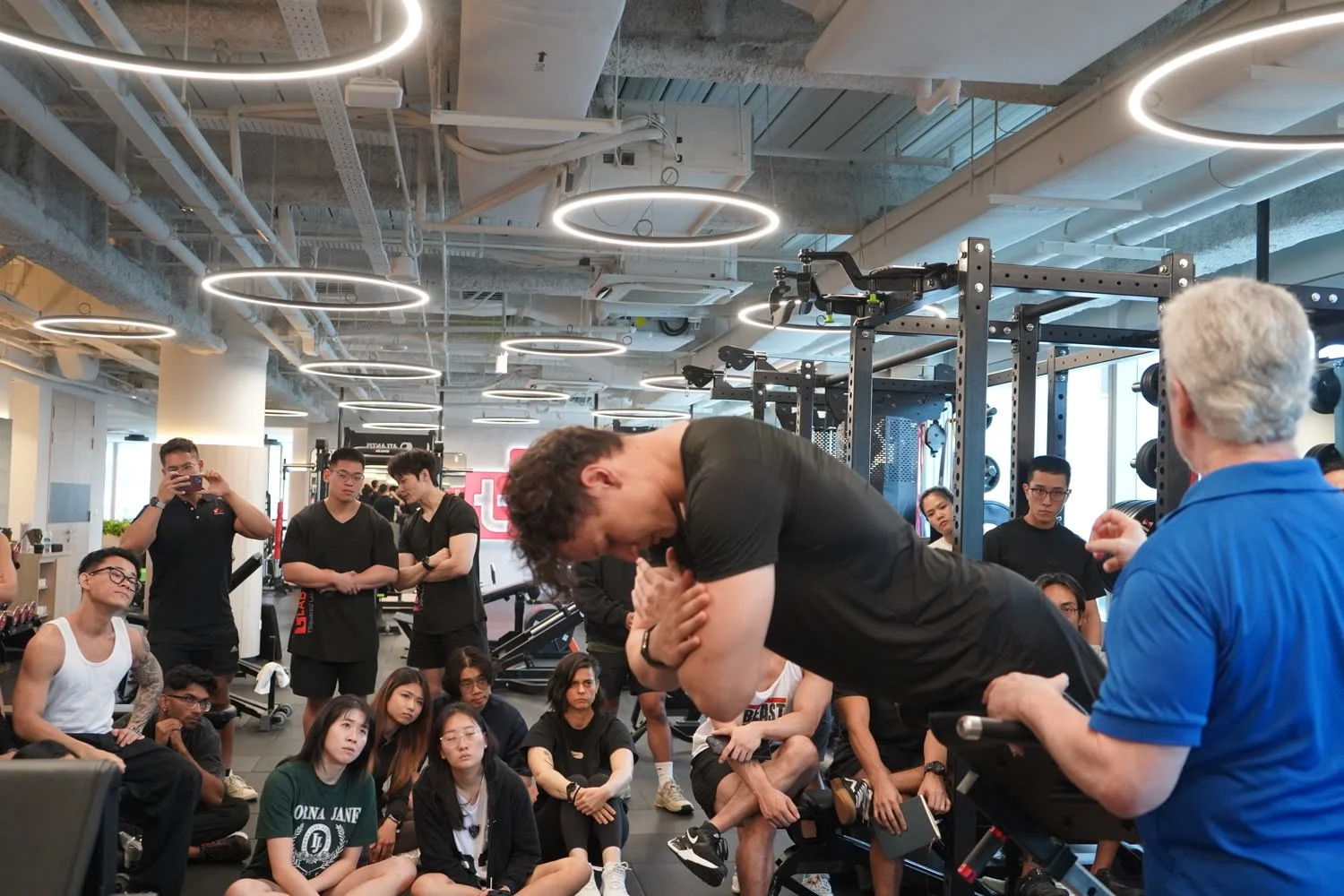
Control isn’t tied to the reformer, so you can coach it in any session. One working set a week each of spinal flexion, extension, lateral flexion and rotation, with your client exploring whatever range feels comfortable under control, covers the “spine benefits” people go to Pilates for. Because you choose the equipment, you can give every exercise a Resistance Profile™ that matches your client’s strength, and keep raising the resistance as they get stronger. If the problem stems from the hips or scapula, the same approach applies to those joint functions.
So when a client asks whether they should be doing Pilates, there’s no need to talk them out of it. If they enjoy it, there’s plenty to gain from controlled, low-stimulus exercise they can do daily. Make sure they know where the results come from, though, because control is something you can give them every time they train with you.
Coaching control takes practice. Start the process on RTS Level 1.