
Running Mechanics, Explained

When people say they "train for running", I wonder what they mean. The best way to get better at running is to run more. What other training do you speak of, friend?
Obviously we need to give some thought to technique, but if we think "good at running" = maintaining maximum speed for maximum time, getting better really means building endurance.
In sports, technique is a performance-based discussion: what will help someone achieve the fastest time?
In the real world, if the goal is running for health benefits, the discussion is different: joints and longevity. (So you can keep running for its cardiovascular benefits until you're old). That gives us other priorities and strategies to think about. If you've spent enough time running or working with runners, you know that all that cumulative tax presents itself in two main problem areas: the knees, and the lower back.
The knee: foot strike and shear forces
Want to reduce joint stress at the knee? Let's talk about the "heel vs toe" strike.
Heel-striking essentially removes the ankle joint from the impact of landing on the front foot. It reduces a 3-joint eccentric to just the knee and the hip, which means those poor fellows have to share and tolerate a lot more of the force of a whole human body landing on one foot, at speed.
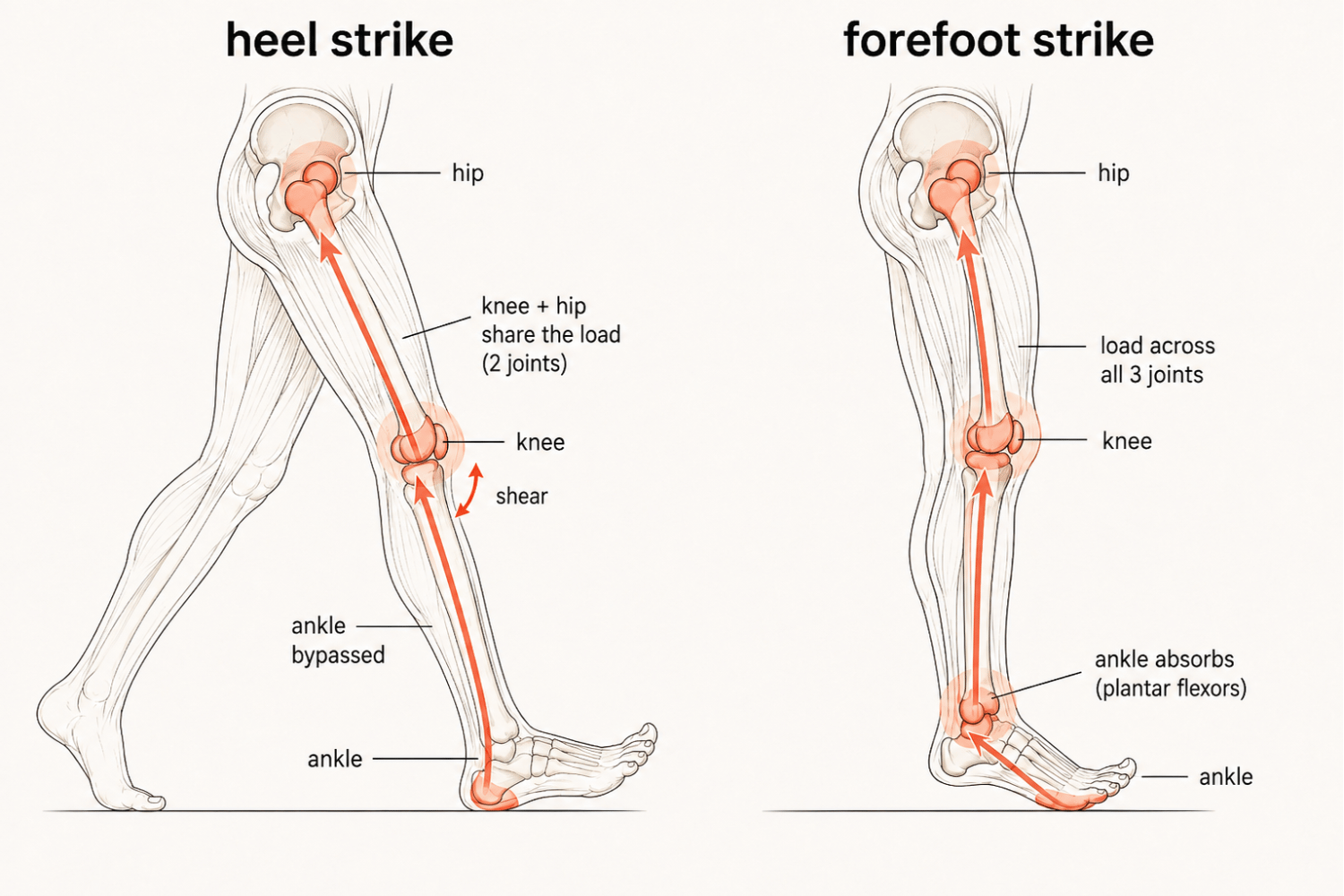
This is only possible with modern footwear and its magical compression foam, which buffers the cushioning effect usually provided by the plantar flexors. If the goal is performance, this could be an efficient strategy of transferring force, and spares the calves the fatigue caused by a toe-striking running style. If the goal is longevity of the knee (and you hear a lot more about knee issues than ankle issues with senior clients), we could consider using the ankles to reduce forces through it as much as possible.
However, the plantar flexors need to be capable of taking on that load from the knees. Strong hip extensors would help, too. A running technique designed to shift forces away from the knees and toward other joints sounds great, but if the muscles around those joints are weak, the brain isn't going to have the luxury of using them. Fatigue and technique do not go well together. Strengthening muscles around the knee also generates more stability, so every joint in the ankle-knee-hip chain is worth training.
“Fatigue and technique do not go well together.”
"Overstriding" is another issue associated with heel-striking. I'm not a running coach, so I won't comment on its relationship to performance. My concern is how much more friction is created by having a longer stride. Having the knee behind the ankle on ground contact creates more shear forces at the knee, which accumulate with every step.
The short version: performance aside, running with shorter, more forefoot-based strides should result in significantly less forces going through the knee. If the goal is for running to be a healthy, cardio-based exercise that keeps you upright and mobile on a daily basis, that's the logical technique. If your goal is competitive action and Instagram-worthy PBs, there may be a different approach.
“Running with shorter, more forefoot-based strides should result in significantly less forces going through the knee.”
The lower back: lateral forces and the QL
With the lower back, we probably need to switch perspectives and consider the lateral forces.
We (or we should) run with one foot on the ground at a time. This means that to maintain a level pelvis and not flop around like a majestic migrating salmon, the muscles that flex our trunk laterally and abduct our hips need to work, and they need to work in opposing synchrony: fire left trunk and right hip, then the other pair.
With the hips and trunk working together, a weaker hip abduction means the trunk muscles have to compensate. These muscles can tend to get "tight" and inflamed, so strength-building strategies for hip abduction should help take some load off the trunk.
If lateral forces are causing discomfort in the lumbar spine, it's likely that the quadratus lumborum (QL) muscles are irritated. The obliques don't attach to the spine, and lats don't often get irritated by running, so they're uncommonly the source of pain. However, like the hip abductor scenario, they could be underperforming, meaning the QL is overworked. That, or the QL could be too weak to endure the repetitive lateral forces involved and are just tapping out too early.
What to train
So, training to increase running speed and volume? Strengthening the hip abductors and lateral flexors would be logical. Before the run itself, similar exercises are also good "warm-ups" to get the tissues primed for engagement.

Investigating the muscles and joint functions involved in running is a marathon, not a sprint. Having read this, you're off to a strong start when it comes to thinking about the external forces created during running, and how to prepare the muscles to manage them internally.
Ever wanted to see what exercise really looks like? Learn how to analyze forces and manipulate movement on RTS Level 1.